.png)

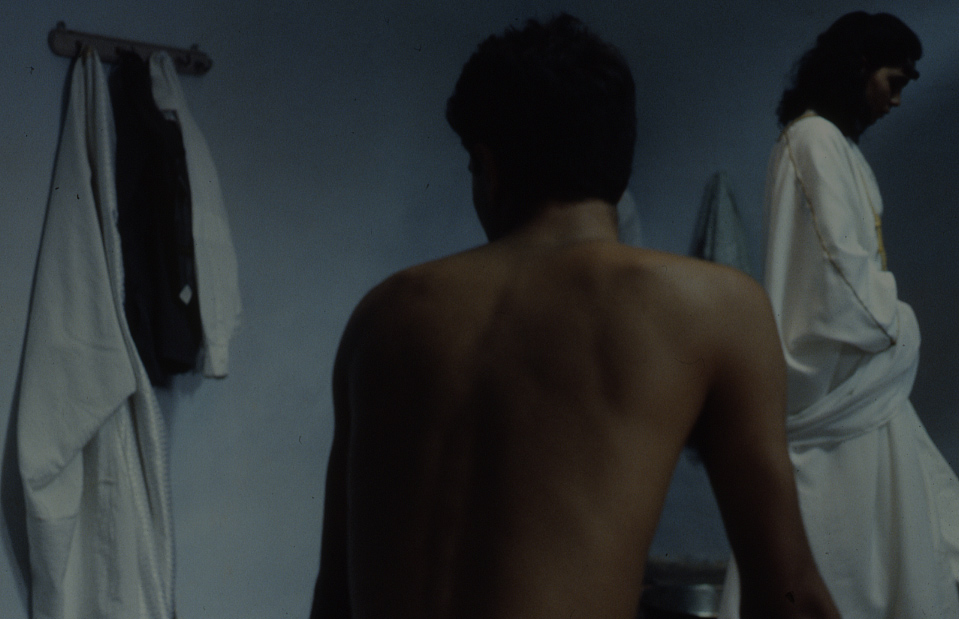
This is the first feature film made in Palestine by a Palestinian director. It is a lyrical, passionate tale of a Palestinian wedding that takes place in an occupied village, and the contemporary tensions, contradictions and hostilities that surround it. The elder of the village, an old patriarchal Arab mayor, wants to marry his son with pomp and circumstance, in accordance with tradition, but his village is under martial law, so he needs Israeli approval to break the curfew as the celebrations will take place all night. He is granted the permission, on the condition that the Israeli military governor and his staff be guests of honour at the ceremony.
The Mayor's family is torn apart by his acquiescence to the Israeli governor's condition, with some of the younger men planning to sabotage the party. The film takes place over two days with tension mounting between members of the family pitted against each other in the face of the Israelis, culminating in the groom's failure to consummate his marriage and his attempt to stab his father, whom he blames for his humiliating impotence. Finally, the Israelis decide to leave and are taunted by the Palestinians, who pelt them with objects in a scene which eerily foretells the first Intifada (uprising), which erupted only six months after the film was shot.

Ma'loul is a Palestinian village in Galilee which was destroyed by the Israeli armed forces in 1948. Its inhabitants were driven out and expropriated. All that remains of the village are two churches and a mosque, the last visible traces for travellers between Haifa and Nazareth. Over the years, they too disappeared, under a forest planted in memory of the victims of Nazism. The Israeli authorities thus wiped off the map hundreds of Arab villages.
But the former inhabitants of Ma'loul have created a new tradition: that of going for a picnic one day a year on the site of their destroyed village, paradoxically on the day of the independence of the State of Israel. It is the day of the picnic that we filmed; the encounter with a stone, a window, a wall, an olive or a pomegranate tree... hidden under the woods. A peasant notes among the young pines certain uncertain landmarks of his lost universe. A family comments with a naive purity on the mural fresco of their village, painted according to traces from their memory. As required by the official Israeli curriculum, a teacher explains to his Arab students the history of the creation of the State of Israel… These are elements of reality that confront each other and make up the film; they allow us to pose a new dimension to the Israeli-Palestinian conflic: that of time.
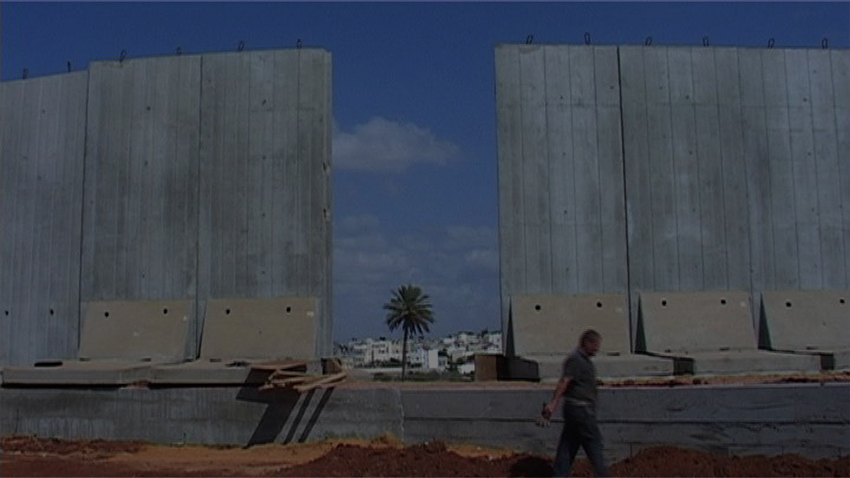
Route 181 offers an unusual vision of the inhabitants of Palestine-Israel, and a common vision of a Palestinian and an Israeli. For more than a year, Khleifi and Sivan dedicated themselves to producing what they considered a cinematic act of faith: a film co-directed by a Palestinian and by an Israeli. In the summer of 2002, for two long months, they travelled together from the south to the north of their country of birth, traced their trajectory on a map and called it ‘route 181’. This virtual line follows the borders outlined in Resolution 181, which was adopted by the United Nations on November 29th 1947 to partition Palestine into two states.
As they travel along this route, they meet women and men, Israeli and Palestinian, young and old, civilians and soldiers, filming them in their everyday lives. Each of these characters has their own way of evoking the frontiers that separate them from their neighbours: concrete, barbed-wire, cynicism, humour, indifference, suspicion, aggression… Frontiers have been built on the hills and in the plains, on mountains and in valleys but above all inside the minds and souls of these two peoples and in the collective unconscious of both societies. With Route 181: Fragments of a Journey in Palestine-Israel, Michel Khleifi and Eyal Sivan take us on a disorientating journey across this tiny territory with vast ramifications.

Yussef, a twelve-year old Palestinian, is a child of the Intifada: while his father is in prison and his brother a fugitive from the Israeli army, he lives alone with his mother and sister. Even though his life is constantly marked by violence, he lives in his imagination, often escaping from the refugee-camps to the Gaza country-side. One day, as he is bird-hunting, he becomes the hero of a modern-day tale: he falls in love with Aida, a young gypsy girl who is the "leader" of a group of children. In order to marry her, Yussef must first find the three jewels missing from a family necklace, brought from South America by the girl's grand-father.
How can Yussef reach such a distant continent? His quest, woven into the daily lives of the people of Gaza, will lead him to his death and at the same time to his resurrection thanks to a wise old man who recites to him the enigmatic words inscribed on a manuscript which Yussef must first find and then throw into a desert well... It is thus that Yussef not only discovers the three jewels but also life and its meaning.

This documentary-feature tells the story of two Palestinians who fall in love during the seventies. Due to the political climate, their relationship is denied its full expression when he is condemned to life in prison for acts of resistance against the Israeli occupation and she emigrates to America to overcome her sorrow.
Fifteen years later, they meet at the height of the first Palestinian Intifada (uprising). She is now a scholar and is in Jerusalem to research the meaning of sacrifice in Palestinian society, only to find him liberated and working for an agricultural aid organisation. Their feelings are rekindled but time has not made things any easier. They are surrounded with chaos and violence and must struggle once more to maintain their bond. This powerful story of a relationship set against the turmoil of the Intifada hovers between reality and fiction, documentary and narrative, poetry and violence.